The short answer
There are three main types of damp: condensation, rising damp and penetrating damp. Condensation comes from moist indoor air settling on cold surfaces; rising damp is groundwater drawn up through the wall base; penetrating damp is water entering through an external defect. Each leaves a different pattern and each needs a completely different fix — which is why correct diagnosis by a qualified surveyor matters before any work begins.
Lumping every damp problem together as “damp” leads to wasted money and recurring misery. The three types behave differently, appear in different places and demand different remedies. This page sets out each one — condensation, rising damp and penetrating damp — with the signs that distinguish them and the less common moisture problems often mistaken for them.
Types of damp at a glance
- Condensation Moist indoor air on cold surfaces
- Rising damp Groundwater up through wall base
- Penetrating damp Water in through an external fault
- Most common Condensation
- Often misdiagnosed Rising damp (over-diagnosed)
- Confirm with Moisture meter + surveyor
Condensation
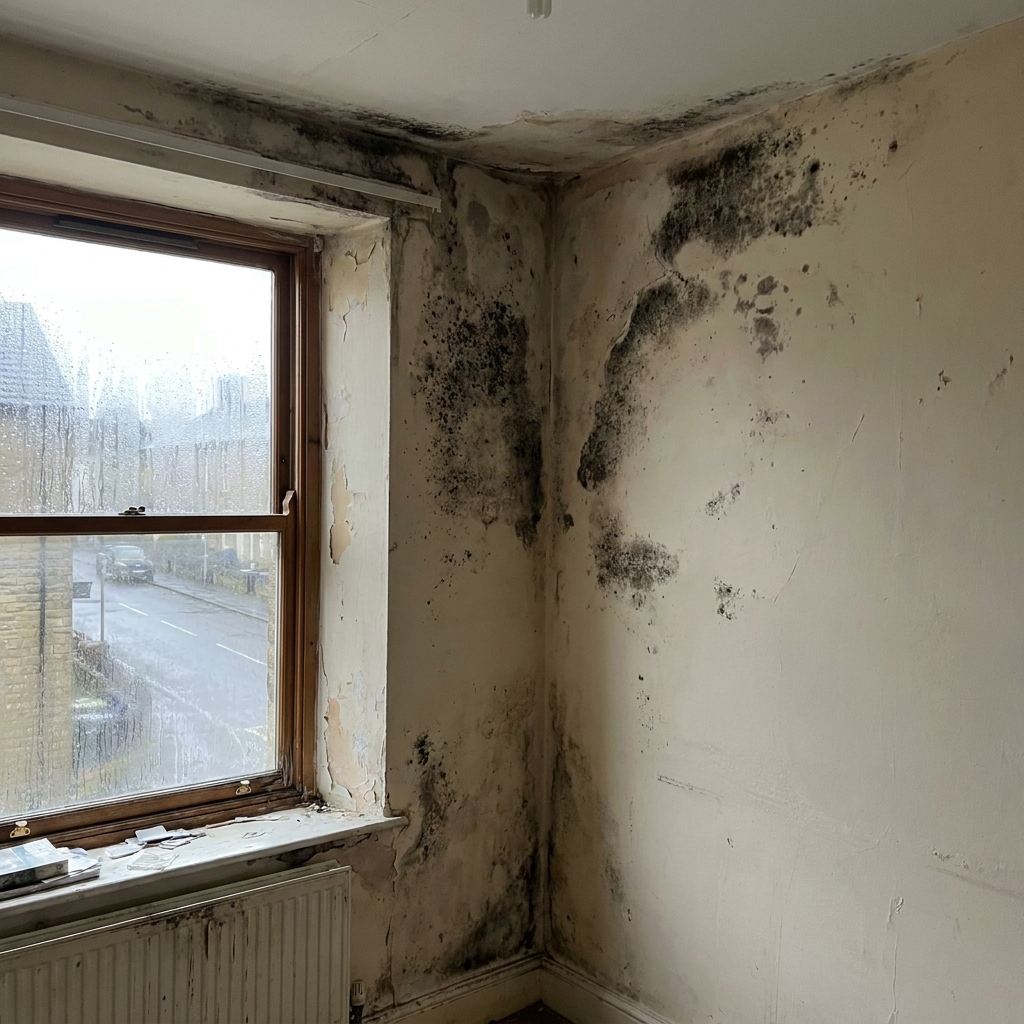
Condensation is the most common form of damp in UK homes. Warm, moist air — produced by breathing, cooking, washing and drying clothes — cools when it meets a cold surface and releases its water, just as a cold drink “sweats” in a warm room. It shows as streaming windows, black mould in room corners and window reveals, and a musty smell. A single household can put several litres of moisture into the air each day, so without enough ventilation that water has nowhere to go but onto the coldest surfaces. The cure is about moisture balance: ventilate, heat steadily and reduce moisture at source. See how to stop condensation.
Rising damp
Rising damp is groundwater drawn upward through the base of a wall by capillary action, the same effect that draws water up a sponge. It occurs where a damp-proof course (DPC) is missing, has failed, or is “bridged” by raised external ground, a render skirt or debris in a cavity. The classic sign is a horizontal tide-mark, usually no higher than about a metre, often with salt staining and perished plaster low on the wall. Genuine rising damp is far less common than it is diagnosed — many cases turn out to be condensation or penetrating damp, which is why a moisture profile should be established before any treatment.
Penetrating damp
Penetrating damp is water entering from outside through a specific building defect: cracked or blown render, defective pointing, a leaking gutter or downpipe, a failed window or door seal, or a roof fault. It tends to appear as a localised patch that worsens noticeably after rain and can occur at any height — not just near the floor. Solid-walled (pre-cavity) homes are more prone to it than modern cavity construction. Fixing it means finding and repairing the defect, then letting the wall dry, rather than masking the inside surface, which only traps the moisture.
| Feature | Condensation | Rising damp | Penetrating damp |
|---|---|---|---|
| Where | Corners, windows, cold walls | Low on ground-floor walls | Localised, any height |
| Pattern | Diffuse, with mould | Tide-mark to ~1m | Defined patch |
| Worst when | Cold weather | All year, ground-fed | After rain |
| Typical cure | Ventilation & heating | New DPC / remove bridging | Repair external defect |
Less common forms
- Construction or “built-in” damp — residual moisture in a new or recently altered building still drying out, which can take months.
- Plumbing or appliance leaks — often mistaken for rising or penetrating damp until the source is traced.
- Hygroscopic salts — old contamination that draws moisture from the air and keeps plaster looking damp even after the original cause is fixed.
The single most expensive error in damp is treating the wrong type. Every year homeowners pay for a chemical damp-proof course when the real culprit is condensation, and the mould simply returns. Equally, ventilating a wall that is actually fed by a leaking gutter will never dry it. Because the remedies are not interchangeable, the order of work is always the same: diagnose the source first, fix that source, then dry the structure, and only then redecorate. A modest survey fee at the start routinely prevents a far larger bill later, and gives you an independent opinion rather than a quote from a firm selling one particular treatment.
Telling them apart
Look at height, pattern and timing. Low tide-marks suggest rising damp; defined patches that follow rain suggest penetration; diffuse mould in cold corners suggests condensation. Because the symptoms overlap, because salts can confuse readings, and because a home can have more than one type at once, anything persistent should be confirmed by a qualified surveyor before money is spent. A correct diagnosis is the single most valuable step, because the cures are not interchangeable: ventilation will never fix rising damp, and a damp-proof course will never fix condensation. This page is general information, not a site-specific survey.
Frequently asked questions
How many types of damp are there?
Three main types: condensation, rising damp and penetrating damp. Other moisture problems — leaks, construction damp and hygroscopic salts — are usually variations or are mistaken for these three.
Which type of damp is most common?
Condensation, by a wide margin. Rising damp is the rarest and is often over-diagnosed; many supposed cases are actually condensation or penetrating damp.
Can a house have more than one type of damp?
Yes. It is common to find condensation alongside a localised penetrating-damp patch, for example. That is one reason a proper survey is worthwhile.
Do different damp types need different treatments?
Yes, and that is the key point. Condensation needs ventilation and heating; rising damp needs a damp-proof course or removal of bridging; penetrating damp needs the external defect repaired.
Sources & further reading
- RICS — Investigation of moisture and its effects in traditional buildings
- Property Care Association (PCA) — Guidance on rising and penetrating damp
- gov.uk — Housing Health and Safety Rating System (HHSRS)
- NHS — Can damp and mould affect my health?
This guide is general information, not a site-specific survey, medical advice or legal advice. Damp and mould should be assessed by a qualified surveyor, and health concerns discussed with a GP or the NHS.